I was working away yesterday when I noticed the ground was shaking. More appropriately, the building was shaking. I'm on the top floor of a building on a hill, so things were shaking quite a bit. It turns out a 6.1 quake hit the town of Panzhihua yesterday, just across the border in Sichuan. This is in a different spot from the one that hit May 12th. There are reports of some casualties and collapsed buildings over there. It's too bad. There are a lot of poor, remote areas in the hills around the area, and Sichuan's still having a tough time in the rescue effort from the previous, more deadly quake.
For everyone with friends out here, Kunming is fine. No damage, as far as anyone has heard. The ground shook again the same time today, but less intense. This is getting old.
Sunday, August 31, 2008


Tuesday, July 22, 2008
Damn Good Wine
Sunday was a particularly fulfilling day. I had given up yet another weekend to my translation work, cramming for two major deadlines. Lo and behold I sent out the documents at five on the dot, a time that means less and less when you’re working at home.
Usually the weather in Kunming is absolutely beautiful while I’m holed up inside at work, and turns to sh-t whenever I have free time. On this day, however, it had been raining all day, but things were just quieting down as I finished the last few sentences.
It’s been a while since I’ve had some quality time on the roof. I grabbed some wine leftover from the night before and moseyed out into the garden with Orhan Pamuk’s “My Name is Red”.
It was as if the clouds had parted just for me. To the east was a low ceiling of grey rainclouds, no doubt still relieving themselves on all my friends over there. On the other side, the Western Hills were dwarfed by a massive, multi-tiered cloudbank. Bathed in the magical golden Yunnan sun and seeming to billow and stack up endlessly, they were definitely renaissance clouds, capturing all the glory of the creation forever on the ceiling of some rich Venetian trader. And right above me was a flawless, endless blue.
Captivating as it was, my Turkish murder mystery just couldn’t beat the weather for pure entertainment value. I grabbed my glass of wine and wandered off to the western edge of the garden. Gnats and flies must have been lured out by the fresh moist air, because I was presented with the spectacle of thousands of dragonflies on the prowl. They filled the sky over the tiny, lush garden valley that the next door slum carved out of the endless rows of housing complexes. If I were down there, I would be able to watch the children chase the dragonflies with nets. Tie a hook on the back of a dragonfly and you have an amazing, living, flying fishing lure to take with you to the lake.
But up here there was a different kind of hunt going on. Sparrows and other small birds, attracted by the buzz of wings, were hunting down the dragonflies, pulling off effortless war maneuvers. I’ve always wondered why, here in the middle of China’s most thriving ecosystems, I only ever saw slum birds. Maybe it’s just too nice out there in the hills.
There is another kind of bird in the picture. Several of my neighbors raise flocks of pigeons on the rooftops. Today there were two flocks out, flying in tight circular formation around the waving flags of their keepers. As I sat back down to my book, the garden was periodically swept by the shadow of these pigeons as they flew overhead. Once I master the pigeon language, I’ll thank them for never shitting on me after so many flyovers.
I glanced back at the massive golden cloudbank over the Western Hills. It was so distant and expansive, it looked almost like a giant movie backdrop. I spotted a black dot in front of one of the clouds. A bird? A plane? No, it’s an old man. In my American youth, kite flying was a father-son sport, where the father would toss the kite in the air and the son would run around seeing how long he could go before the kite hit the ground or caught a tree. In China, kite flying is about old men in the park effortlessly launching their kites into the stratosphere. On any good day one can spy tiny clusters of black dots hovering motionless over the city.
Seeing all this beauty at once reminded me why I had missed Kunming so much during my dust-covered days fighting through the social ladders of Beijing. It reminded me why I call this place home, why I had quit my corporate job and come back here to live the quiet life of a translator.
I leaned back, listened to the birds overhead and enjoying the warmth of the afternoon sun on my back, and I thought, “damn, that’s some good wine.”
Saturday, April 19, 2008
A Word of Optimism
Let's go back to take a look at what I was talking about in my last posting. I still feel that a bit of caution is necessary in dealing with the Chinese art market, but things are still going well. The Sotheby's auction actually went quite well, and prices stayed quite high. One example, Zhang Xiaogang, saw a single painting from his much sought after Bloodlines series sell for HKD 42 million.
I still see a bubble looming on the horizon, but whatever happens, Chinese art is here to stay. One of the biggest reasons for optimism is that the Chinese themselves are starting to acquire a taste for art. We're starting to see more local collectors, and they're more than just a bunch of successful artists buying each others' works. That's a good sign, as the political situation in the past allowed Chinese contemporary art to explode without causing even a blip on the local cultural radar. Foreign collectors were snapping everything up, and most of the locals were none the wiser. We're even seeing homegrown corporate and institutional investment in art, thought that's still in its infancy. One of the most promising new developments is the arrival of homegrown non-profit art organizations and events, which is absolutely necessary if we're to see a renewal of dialog between artists and the society around them.
The scene in general is slowly growing beyond a simple market organization. Beijing's 798 Art District is now home to two large art centers, the Ullens Center (founded by a big-time European collector) and the Iberia Center (founded by the International Art and Culture Foundation of Spain). Though foreign, these two institutions are more focused on exhibitions, education and outreach than pure sales. In fact, they're not selling, at least not the stuff they exhibit. Overall that's a good thing, but the fact that 798 and a lot of the other art districts are located on the edges of this sprawling city guarantees that the Chinese art scene will remain an insider game for a long time.

opening day at the Iberia Center
I was quite impressed the other day when I attended the Iberia Center's opening exhibition. They've rounded up a lot of talent, leaning towards younger, more adventurous curators and organizers. Another good sign is their film center, which will house a media archive, studio and screening room for independent documentary film. To make this happen, they've tapped Zhang Yaxuan, who is definitely one of the most knowledgeable and active figures on the scene. I met her a long time ago at Yunfest, and I'm really glad to see that someone's willing to give her the money and resources she needs to take things to the next level.
There are still a lot of problems with the art scene, and I could make a long, boring list of them (and don't worry, I will keep ranting in the future), but I think they all boil down to a single problem, which is that they've never seen a bubble. Bubbles happen all the time in New York, London and Paris, and eventually people pick up the pieces and wise up a bit. It's a necessary process that weeds out the bad seeds every once in a while. But the more I look into it, the more I'm convinced that this run still has some legs. There are a lot of collectors who are just getting into the market, and a lot who haven't made it out yet. Just as with everything else in China, everyone wants a piece. Hopefully things won't get too out of hand.
I still see a bubble looming on the horizon, but whatever happens, Chinese art is here to stay. One of the biggest reasons for optimism is that the Chinese themselves are starting to acquire a taste for art. We're starting to see more local collectors, and they're more than just a bunch of successful artists buying each others' works. That's a good sign, as the political situation in the past allowed Chinese contemporary art to explode without causing even a blip on the local cultural radar. Foreign collectors were snapping everything up, and most of the locals were none the wiser. We're even seeing homegrown corporate and institutional investment in art, thought that's still in its infancy. One of the most promising new developments is the arrival of homegrown non-profit art organizations and events, which is absolutely necessary if we're to see a renewal of dialog between artists and the society around them.
The scene in general is slowly growing beyond a simple market organization. Beijing's 798 Art District is now home to two large art centers, the Ullens Center (founded by a big-time European collector) and the Iberia Center (founded by the International Art and Culture Foundation of Spain). Though foreign, these two institutions are more focused on exhibitions, education and outreach than pure sales. In fact, they're not selling, at least not the stuff they exhibit. Overall that's a good thing, but the fact that 798 and a lot of the other art districts are located on the edges of this sprawling city guarantees that the Chinese art scene will remain an insider game for a long time.
opening day at the Iberia Center
I was quite impressed the other day when I attended the Iberia Center's opening exhibition. They've rounded up a lot of talent, leaning towards younger, more adventurous curators and organizers. Another good sign is their film center, which will house a media archive, studio and screening room for independent documentary film. To make this happen, they've tapped Zhang Yaxuan, who is definitely one of the most knowledgeable and active figures on the scene. I met her a long time ago at Yunfest, and I'm really glad to see that someone's willing to give her the money and resources she needs to take things to the next level.
There are still a lot of problems with the art scene, and I could make a long, boring list of them (and don't worry, I will keep ranting in the future), but I think they all boil down to a single problem, which is that they've never seen a bubble. Bubbles happen all the time in New York, London and Paris, and eventually people pick up the pieces and wise up a bit. It's a necessary process that weeds out the bad seeds every once in a while. But the more I look into it, the more I'm convinced that this run still has some legs. There are a lot of collectors who are just getting into the market, and a lot who haven't made it out yet. Just as with everything else in China, everyone wants a piece. Hopefully things won't get too out of hand.
Wednesday, April 09, 2008
A Word of Caution
The Chinese art phenomenon continues, and shows no signs of abating despite all of the economic problems. Once relegated to the underground, Chinese contemporary art has hit the mainstream in a big way ever since it began raking in untold billions. At the various gatherings of artists, critics, dealers and hangers-on recently I’ve seen nothing but optimism and enthusiasm, with everyone waiting expectantly for the next big thing to explode on the scene. Sotheby’s and Christies (not to mention Poly, Guardian and a host of new mainland upstarts) are gearing up for ambitious spring offerings, and no one seems phased by the financial meltdown at all.
I don’t see any big surprises happening this season, but I am seeing good reason to be cautious over the coming months. Having just walked away from a speculation bubble in the tea market, I may be a little biased, but more than a few art insiders have been expressing a lot of curiosity about that bubble recently, so maybe we’re on to something.
The first issue is that the market has gotten too big, too fast. Though I think that a good Zhang Xiaogang painting is worth every penny of $1-2 mil, I’m seeing way too many artists in the upper mid-range, selling at tens to hundreds of thousands. I think that Chinese artists are producing some of the best art in the world right now, but I have a little trouble swallowing the idea that hundreds of Chinese artists are going to make it into the world art history books and make their mark on the emerging global aesthetic. The prices now would reflect the expectation that each and every one of those guys will be the next Basquiat.
Much of the buying and selling I’m seeing seems to be focused on potential future value, with artworks treated as financial tools rather than objects of desire. It’s easy to fall in this trap when a work that was sold by a starving artist for a few hundred dollars in the eighties is now hitting the auction block for hundreds of thousands. Puer tea traders fell in the same trap when they saw the ’88 Qing vintage start at thirty cents and top off at 1500. The bottom fell out of that market when everyone realized that there was too much production and speculators outnumbered drinkers by several orders of magnitude.
I could go on and on about this, but to make a long story short, approach Chinese art with caution. If you’re entering into the market strictly to cash in, you’re likely to get burned, sometime soon. Having said that, if you’re in it for the art, a careful approach should reward you with some great stuff for your collection.
A slightly clumsy English version of Zhu Qi’s article is available here
The original article is available on Zhu Qi's Blog
Free as a Bird

It’s a beautiful, kind of sunny spring day as the train rolls its way past the towering apartments of Kowloon on its way to Mainland China. I’ve been in Hong Kong for the past few days sipping free champagne, chomping on finger snacks and looking sideways at little blocks of color, thinking of profound-sounding things to say to impress pretty young women in cocktail dresses.
That’s right, it’s art season. Actually, it’s the feeding frenzy that leads up to the massive Sotheby’s spring auction, which this year is making one of its largest offerings of Chinese contemporary art ever. A long run of record-shattering auction prices for Chinese contemporary has attracted the players from every corner of the industry for a week-long session of art shows, banquets, name card exchanges and mass bar runs. I can’t claim innocence here; I came down specifically to join the cheering section for one of my favorite artists and clients, Ye Yongqing.
Commander Ye, as we call him, is an interesting case. He was extremely important in the conceptual and artistic movements of the eighties, collectively called the ’85 New Wave, and became even more so during the nineties as he travelled the nation and the globe not to promote himself but to promote the development and recognition of Chinese art, and to build links with other budding scenes especially in the Third World.
He was one of the first artists to enlist me in the field of art translation, and he has always been one of my staunchest supporters, nearly singlehandedly responsible for my reputation and client base (I can take at least a little credit in that department).
The funny thing is, I didn’t really become familiar with his art until about a year ago, and though his work is highly respected by fellow artists, he never really took off on the market or in the media until recently. There’s a very simple explanation for that – he’s just too damned busy. It’s surprising he’s had any time at all to develop his creative style what with his job as a professor at the Sichuan Academy of Fine Art, his founding of one of China’s first bona-fide art communities (Upriver Loft, Kunming) and his dozens of trips around the world to foster intercultural exchange. Yet his artistic style has followed an amazing trajectory, from his early days as a bit of an impressionist and dabbler in cubism, through his graffiti and archaeology inspired conceptual experiments of the nineties to his somewhat abstracted, highly meticulous and meditative works today, his artistic path has stretched farther than many artists half as busy as he.
His work now consists mostly of large birds or giant squiggles scrawled onto roughly treated canvases. From a distance they appear to be composed of broad, carefree strokes, but a closer look reveals that these are works of excruciating labor, made of thousands of tiny “chicken-scratch” strokes with a tiny brush.
The birds and squiggles resemble smaller ones that often featured in his earlier works. He often used birds and cages to play with ideas about freedom and confinement, and his own life is best described as migratory, which also helps explain the fascination. The squiggles are a bit less clear, but he’s always been playing with graffiti and scribble effects.
The term that pops to mind when trying to describe his recent works is “meditations”. To him, painting seems to have become a meditative exercise, and the resulting images the embodiment of the mental state he reaches. In this way, he shares as much in common with the traditional Chinese painters of old as he does with his peers in contemporary art.
But I’m not a critic, I’m a party crasher, and my skills in that department were put to great use this week. The main event was the most comprehensive Ye Yongqing retrospective ever held. It was organized by Anna Ning a young, up and coming dealer in Hong Kong, but it drew from many collectors and galleries to bring out pieces from almost every important stage in his development. Call me a cynic, but I have a feeling that this cooperative spirit was aided more than a little bit by the fact that a few of Ye’s works are going on the auction block this week.

Anyway, Anna did it up right, taking over a great space at the Hong Kong Art Center and putting a bunch of us up at the lavish Grand Hyatt right on the edge of the harbor, and coincidentally, a stone’s throw away from the Sotheby’s preview show.
So many people made the trip out that there were jokes about an evil cult assembly, mafia election or alien invasion. Whatever it was, once you get a few dozen darkly dressed Chinese guys in shaved heads together, you’re bound to attract some stares.

The opening was followed by a lavish five course meal for nearly 100 guests at the lovely Verandah Restaurant in Repulse Bay. We must have drained half their wine cellar that night. I had a chance to catch up with some of my favorite artists and meet some great people from the gallery, auction and critique fields. I decided to stay another couple of days to check out the Sotheby’s preview and crash the opening for Chen Jiagang’s exhibition.
Chen Jiagang is the current flavor of the month with a series of captivating photographs staged in the ruins of the Third Front, an area of China’s hinterland that Mao built up with military factories to shield them from an American nuclear strike. The massive buildup is now slowly returning to the soil, and the people who once ran it are now the forgotten heroes of China’s maniacal political history. His photos are lovely, but he’s become an overnight star and one must wonder if he’ll be able to live up to the hype in the future.
That was the inaugural show for Contemporary by Angela Li. Angela has been working in the field as a consultant for many years and is now going into full time business. She’s smart, personable and attractive, and I have every reason to believe she’s going to have a long and fruitful career. She definitely knows Chinese art like the back of her hand.
The after-party was held at the China club, on top of the old Bank of China building. Step through the doors and you’re in 1930’s Shanghai. They’ve done a beautiful job making the atmosphere there, and David Tang’s impressive art collection makes it just that much more special. But it was the view from the top floor balcony that stole the show. I tend to favor natural scenery, but I have to admit, Hong Kong is one of the most striking modern cities I’ve ever been to.
All in all, Hong Kong was a blast. In the past it was just a place for me to refill my China visa and load up on English books, magazines and cheap tailored suits. Now I’ve finally had a chance to see more of the city, and though I don’t think I’d want to live there, I’ll jump at the chance to go back.

Saturday, March 29, 2008
A(mao)rica's Idol
Today I was watching the “All China Youth Singing Competition”, a yearly extravaganza held on China's national television network. I'm only watching this stuff because I have a few friends in the competition. This very odd television show is one of the most important trials for any young person who wants to survive in China's music industry. Every province and region sends representatives, and the prize for winning is national fame, endorsements and the ability to command high performance fees.
When I turned on the TV, a beautiful Mongolian girl in a golden dress was singing a lovely flowing song from the grasslands she calls home. It wasn't the best folk song I'd ever heard, but then again I've heard a lot of this stuff in my day. But here's the clincher: when she finished her song, an announcer took the stage and asked her a question - “The Summer Palace and The Great Wall are the English names for two famous Chinese landmarks. What are their proper names in Chinese?
I have to say that the perversity of this whole spectacle never ceases to amaze me, even after all these years. Apparently a singer, even a folk singer, cannot be a true professional unless her head is crammed with all kinds of trivia that is wholly irrelevant to her life or career.
Of course, the girl was stumped by the question, and that's going to hurt her score in the long run. She didn't make the cut because she doesn't know the English names of two tourist sites in Beijing, a city worlds apart from where she was raised. One of the judges (there are about thirty of them and they're all really old) made the following remark: “Some people may be wondering why we've added so many English questions to this year's trivia section. It is because there will be many foreigners here this year for the Olympics, and we need to be able to tell them about our great historic landmarks.” There you have it folks, she can't be a superstar because she hasn't made enough effort to become a perfect Chinese citizen in the party's image. Don't believe me? Wait until you hear the next question they asked her. Footage from some Cultural Revolution music video was shown for a few seconds, and she was asked to name the song. Of course, this time it was multiple choice, because the Cultural Revolution was a long time ago and the Olympics are THIS YEAR. So just in case you stumble on a foreigner deep in the Mongolian steppe who is looking for the Summer Palace, make sure you know enough English to tell him that he's hopelessly lost, otherwise you'll never be a superstar.
Other questions I've seen include “name the cities that these famous European soccer teams are from”, and “name the period that this Italian Opera piece was written in”. And the topics are numbered instead of named, so you have no way of shooting for a topic you're good at. In fact, they're so worried about people cheating on the test that they release no information that might help people prepare for it. You either know it or you don't.
But don't worry, my people tell me the whole thing's fixed anyway, so there's no use in memorizing that encyclopedia.
Monday, December 24, 2007
Caravan Stop 1 – Kunming

I’ve ranted and raved a lot about
The museum is right down by
One of my favorite exhibits there is called “Memories of Mankind”, which is a complete collection of every form of written language and communication system found among the peoples of
Every time I go to the museum, I end up spending most of my time (and money) in either the bookshop or the clothing shop. The book shop is entirely dedicated to books on
Unfortunately I didn’t get to spend a whole lot of time blowing my wallet that day, because the lecturers were on a tight schedule. Our first lecture of the day was by Mu Jihong, something of a legend among puer tea fanatics. Some time in the nineties, he and a few colleagues heard chatter about a possible southern passage on the
The six men returned and named the trading route the “Ancient Tea and
Our next speaker is an old friend of mine, Guan Yuda. He teaches art at
Our last speaker was Li Kunsheng, incidentally also a professor at

Our last major happening in

On the Caravan Trail
My latest trip to

We had a simple goal, to learn as much as we can about the history, traditions and cultures of the Caravan Trail, and record as much as we could in photos, interviews and sketches (there were three artists in the group). After some time in
Friday, September 28, 2007
The Story of Tea
 I recently recieved an advance copy of the new book The Story of Tea: A Cultural History and Drinking Guide by my friends Mary Lou and Robert J Heiss. I have to say, I am quite impressed. The heavily illustrated book is organized rather like a textbook, and covers a wide swath of tea knowledge, from history to cultivation to production, culture and accessories. It even has a section with tea-based food recipes. The knowledge in there is spot on, as the Heisses have been travelling around the world and researching the background for a long time. But what makes this book really great, aside from being a solid reference tool, is the writing. The book, though organized like a textbook, reads like a piece of literature. One can see right away how the authors are totally captivated by this great beverage. I've read a lot of books about tea, and most of them tend to mystify the subject, as if the leaf is some holy, esoteric thing that should be romanticized but not approached scientifically. The authors manage to work in a lot of the romance and allure of this leaf without trivializing, mystifying or being condescending. Here's one of my favorite bits, from the opening of Chapter 7:
Imagine the following: a Japanese tea master wishing to teach his student the importance of perception dashes a cup of tea to the ground, breaking the cup and spilling the tea. The tea master wished to illustrate the point that the broken cup was no longer a cup but just a pile of shards, while the tea was still tea, immutable and unchanged. But as the tea could no longer be consumed without the cup to hold it, the true importance of the cup becomes clear. It is the empty space of a teacup that performs the most essential duty, one with greater importance than merely the fleeting beauty of a pleasing shape, fetching design or lustrous glaze.
I first met the Heisses while on the Yunnan Revealed tour in 2005 when we performed at Dartmouth College. They were fawning over our handcrafted Yunnanese instruments, and bought some of our best pieces with little hesitation. I was working the craft table that night, so I moseyed over and introduced myself. We quickly figured out that we were all tea nuts and entranced with Yunnanese culture. Since then we've kept in touch, trading shop talk and stories about China. The Heisses have a shop in Northampton Massachusetts called Cooks Shop Here, which provides high quality cooking products for good cooks. Somewhere along the line they turned their attention to tea, and have since crafted themselves into what NYTimes foodwriter Nina Simonds calls professors of tea. They have amassed over 100 varieties of the leaf for their dedicated customers, and in the process have travelled around the world to learn and source the good stuff, and have brought their culinary approach to ingredients on their investigations of what this stuff is and what you need to know.
This is a great book and a must-read for anyone who is interested in tea. People across the west are beginning to get the idea that there's a lot more to this beverage than bagged black tea and iced tea in the bottle, but taking a peek at this vast world with thousands of tea types and grades of quality from nearly fifty countries can be intimidating. Put a copy of this on your coffee table (sic) and you're set for your new adventure.
Monday, September 17, 2007
Mike the Bike
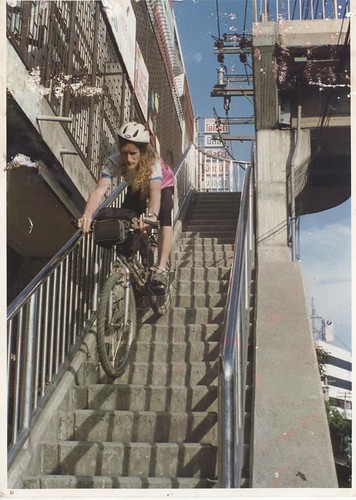
On the afternoon of August 26th, Michael Sutherland – known as Bike Mike to his friends – died in a rafting accident in Mi’le County, south of
The three bodies were found and identified by one of the survivors who stayed behind for five days to assist the massive search party and liaise with the US Consulate and Mike’s family.
Bike Mike was one of my closest and oldest friends in
Bike Mike arrived in
It is hard to find someone in this town who hasn’t been affected by Mike’s life here. He spent many years traveling around the area, and built a business upon the longstanding hemp traditions of
But it was the personal touch that we’ll remember the most. Mike was always eager to take in wayward travelers, offering a place to stay, the run of the town and his unique insights into the people and places of

I miss you bro.
Subscribe to:
Posts (Atom)

