Saturday, March 29, 2008

A(mao)rica's Idol

Today I was watching the “All China Youth Singing Competition”, a yearly extravaganza held on China's national television network. I'm only watching this stuff because I have a few friends in the competition. This very odd television show is one of the most important trials for any young person who wants to survive in China's music industry. Every province and region sends representatives, and the prize for winning is national fame, endorsements and the ability to command high performance fees.

When I turned on the TV, a beautiful Mongolian girl in a golden dress was singing a lovely flowing song from the grasslands she calls home. It wasn't the best folk song I'd ever heard, but then again I've heard a lot of this stuff in my day. But here's the clincher: when she finished her song, an announcer took the stage and asked her a question - “The Summer Palace and The Great Wall are the English names for two famous Chinese landmarks. What are their proper names in Chinese?

I have to say that the perversity of this whole spectacle never ceases to amaze me, even after all these years. Apparently a singer, even a folk singer, cannot be a true professional unless her head is crammed with all kinds of trivia that is wholly irrelevant to her life or career.

Of course, the girl was stumped by the question, and that's going to hurt her score in the long run. She didn't make the cut because she doesn't know the English names of two tourist sites in Beijing, a city worlds apart from where she was raised. One of the judges (there are about thirty of them and they're all really old) made the following remark: “Some people may be wondering why we've added so many English questions to this year's trivia section. It is because there will be many foreigners here this year for the Olympics, and we need to be able to tell them about our great historic landmarks.” There you have it folks, she can't be a superstar because she hasn't made enough effort to become a perfect Chinese citizen in the party's image. Don't believe me? Wait until you hear the next question they asked her. Footage from some Cultural Revolution music video was shown for a few seconds, and she was asked to name the song. Of course, this time it was multiple choice, because the Cultural Revolution was a long time ago and the Olympics are THIS YEAR. So just in case you stumble on a foreigner deep in the Mongolian steppe who is looking for the Summer Palace, make sure you know enough English to tell him that he's hopelessly lost, otherwise you'll never be a superstar.

Other questions I've seen include “name the cities that these famous European soccer teams are from”, and “name the period that this Italian Opera piece was written in”. And the topics are numbered instead of named, so you have no way of shooting for a topic you're good at. In fact, they're so worried about people cheating on the test that they release no information that might help people prepare for it. You either know it or you don't.

But don't worry, my people tell me the whole thing's fixed anyway, so there's no use in memorizing that encyclopedia.

Monday, December 24, 2007

Caravan Stop 1 – Kunming


I’ve ranted and raved a lot about Kunming before, so there’s no need to introduce the place again. We came on a mission, but we were basically there to soak up some of what the city had to offer. Between marathon meals and walks in the park, we actually managed to get some work done. For the first day, I called on my old friend Xie Mohua who is the director of the Yunnan Minority Nationalities Museum, which in my opinion is one of the most overlooked gems in the city. He gave me big face by offering us free access to the museum with his top researchers acting as guides, then free use of his lecture hall. He also brought out some of Yunnan’s top historians to tell us what they know about ancient Yunnan and the caravans.

The museum is right down by Lake Dian on the southwest edge of the city, across the street from the zoo-like Yunnan Nationalities Village theme park. Though most tourists only bother to visit the theme park for a dose of cultural misconceptions, the museum is almost always empty. It has an amazing collection of Yunnan clothing and textiles, as well as just about any artifact you can imagine including religious implements, musical instruments, ritual masks, hemp looms and weaponry.

One of my favorite exhibits there is called “Memories of Mankind”, which is a complete collection of every form of written language and communication system found among the peoples of Yunnan Province. There are stacks of Tibetan sutras, Yi scriptures and Thai palm-leaf sutras. There are old texts in the Dongba script from the Naxi of Lijiang, which is the only pictographic script still in use today. One can also see the Daoist paintings of the Yao people, who adopted Daoism and the Chinese writing system, though they changed it around along the way making the Chinese characters something akin to the work of an American tattoo artist. One of the most interesting sections of the exhibit is reserved for communication by illiterate peoples. In one culture, sending palm leaves woven in a certain way tells the recipient “I like you a lot, but I’m in a relationship right now. Sucks to be you.” A chili pepper sent to a relative says “it is time to exact our revenge”.

Every time I go to the museum, I end up spending most of my time (and money) in either the bookshop or the clothing shop. The book shop is entirely dedicated to books on China’s minority cultures, and any Chinese book on the topic worth its salt can be found or ordered there. The clothing shop downstairs is a well kept secret among textile nuts that I am revealing for the benefit of my handful of dedicated readers. The shop is run by the museum’s former appraiser, who basically oversaw the purchase of the museum’s entire collection. Ms. Wu now uses her extensive contacts in the countryside and her keen collector’s eye to track down the best traditional clothing, embroidery, jewelry and knickknacks to be had in Yunnan. The shop is overflowing with the stuff, but I haven’t come across a single item that she couldn’t pinpoint to its exact village and ethnic origin. Ms. Wu claims that 90% of her business is in long term repeat buyers, and I believe her.

Unfortunately I didn’t get to spend a whole lot of time blowing my wallet that day, because the lecturers were on a tight schedule. Our first lecture of the day was by Mu Jihong, something of a legend among puer tea fanatics. Some time in the nineties, he and a few colleagues heard chatter about a possible southern passage on the Silk Road. Somehow, artifacts from Yunnan and Sichuan were turning up in places like Kazakhstan, and it just didn’t make sense for this stuff to travel all the way up to Xian to cross the desert or all the way across India to end up in Central Asia. Mr. Mu and five others got together to tackle the problem, and soon honed in on the old Tibetan traders that used to send caravan teams into Yunnan for tea and salt. They made a small caravan team of their own to retrace the path and find out everything they could. They found that the caravan trading routes were much more extensive than previously believed, stretching across Yunnan, Sichuan and Tibet, and reaching into India and Central Asia. The trade dates back at least 4000 years. In later ancient times, Yunnan and Tibetan merchants amassed large fortunes trading tea and salt (two scarce necessities on the Tibetan Plateau) for prized Tibetan horses, which they sold to the Chinese Empire, which was always under attack from northern nomads.

The six men returned and named the trading route the “Ancient Tea and Horse Road”, as they saw plenty of tea and horses, but not a lot of silk. Mu Jihong gave us a wonderful account of his travels, and explained the economics and history of the trading route to us.

Our next speaker is an old friend of mine, Guan Yuda. He teaches art at Yunnan University, and gave our people a background on Yunnanese art and culture, as well as a colorful explanation of why the place has always been a vortex for all kinds of whackos. A lot of people don’t realize this, but Yunnan is one of the most important places in China for modern and contemporary art, and also served as an important conduit for the exchange of artistic ideas across Asia in ancient times (more on that in the Dali section). One of the first modern art movements to make waves abroad was the Yunnan school in the early eighties, with its flashy and seductive oil color renderings of Yunnan’s tropical borderlands. That was just a blip on the map, but China’s contemporary art scene has exploded on the world stage, and no other province, region or city has produced more tier one artists than Yunnan. We’re talking Mao Xuhui, Ye Yongqing, Tang Zhigang and Pan Dehai, not to mention Zhang Xiaogang who is currently number one in terms of sales prices and cultural influence. Guan’s explanation is that Yunnan has always been exposed to and receptive of outside influences. It has always been an amazingly diverse (and poorly controlled) frontier region as well as a dumping ground for bad elements and banished officials from Beijing. Yunnan’s modern culture dates back to the ‘30’s when China’s entire top-tier education system sought refuge there from the Japanese, establishing the Southwestern United University, flooding the city with China’s most forward-thinking intellectuals. They bumped shoulders with the French, who still hoped to make it part of Indochina, and the Americans who came as the volunteer fighting outfit soon to be dubbed the Flying Tigers. Yunnan today still beckons to lost souls from all generations who wander there for various personal reasons and end up smoking dope, dancing barefoot and bringing home the seeds of China’s new bohemian culture.

Our last speaker was Li Kunsheng, incidentally also a professor at Yunnan U. He teaches in the history department, and is one of the most important minds in Yunnan archaeology and ancient cultures. He gave us a rundown of the political and cultural situation of Yunnan during the Nanzhao and Dali kingdoms, a period of several centuries that coincided with the Tang and Yuan dynasties in the rest of China. The Nanzhao Kingdom is believed to have been a kingdom of the Yi people centered in Dali. It traded with Tibet, China and India, and at its height controlled a territory stretching across the province and all the way to the Indian Ocean. It held its own against the peak of ancient Chinese civilization (the Tang) and once even defeated an army of 100,000 soldiers. One of its greatest cultural treasures is the series of stone carvings in the mountains of Shibaoshan, which I will return to in the Dali chapter.

Our last major happening in Kunming was a dose of traditional folk culture as it lives and breathes. I took my posse to check out another posse of mine, the Yuansheng dance group. This is a folk-based group consisting of a lot of the traditional dancers we brought to the states in 2005 (see Yunnan Revealed ). They’ve built a theatre in Kunming’s Loft Art Community and have been holding regular performances there for the past year. It was great to see my old friends. They’re living well, spreading the word of cultural preservation, and gaining support in their continuing community work. The hypnotic music brought me back to one of the best moments in my life, stirring up some of the happiest and saddest memories of my days in Kunming. It was the first time for my posse, and they were absolutely blown away. I’m glad that they got to learn a bit about Yunnan from bona-fide peasants, because they represent Yunnan and what it’s about much more than any group of the most accomplished scholars.


The rest of my weekend was about preparing for the trip and going out for drinks with a lot of old friends you’ve never heard of. I won’t bore you with the details. Next installment, the trading town of Weishan and the mighty kingdom of Dali…

On the Caravan Trail


My latest trip to Yunnan was an interesting one, finally fulfilling a longstanding urge to get some more travel in. This time I was on the company dollar and had seven people in tow. We were making a research trip along the Tea Caravan Trail, for a really interesting project that I can’t quite talk about yet.

We had a simple goal, to learn as much as we can about the history, traditions and cultures of the Caravan Trail, and record as much as we could in photos, interviews and sketches (there were three artists in the group). After some time in Kunming running around the Minority Nationalities Museum and soaking in the wisdom of the experts, we hit the road heading west. Our travels took us through Weishan, Dali, Jianchuan, Lijiang and Deqin, from the central heartland to the Tibetan border. I had been to most of these places before, but it’s been a long time. We ran into some old friends, made some new ones, and saw some stuff I’d never seen before. It was a rocking trip. I’ll introduce a bit about each place below.

Friday, September 28, 2007

The Story of Tea

I recently recieved an advance copy of the new book The Story of Tea: A Cultural History and Drinking Guide by my friends Mary Lou and Robert J Heiss. I have to say, I am quite impressed. The heavily illustrated book is organized rather like a textbook, and covers a wide swath of tea knowledge, from history to cultivation to production, culture and accessories. It even has a section with tea-based food recipes. The knowledge in there is spot on, as the Heisses have been travelling around the world and researching the background for a long time. But what makes this book really great, aside from being a solid reference tool, is the writing. The book, though organized like a textbook, reads like a piece of literature. One can see right away how the authors are totally captivated by this great beverage. I've read a lot of books about tea, and most of them tend to mystify the subject, as if the leaf is some holy, esoteric thing that should be romanticized but not approached scientifically. The authors manage to work in a lot of the romance and allure of this leaf without trivializing, mystifying or being condescending. Here's one of my favorite bits, from the opening of Chapter 7:
Imagine the following: a Japanese tea master wishing to teach his student the importance of perception dashes a cup of tea to the ground, breaking the cup and spilling the tea. The tea master wished to illustrate the point that the broken cup was no longer a cup but just a pile of shards, while the tea was still tea, immutable and unchanged. But as the tea could no longer be consumed without the cup to hold it, the true importance of the cup becomes clear. It is the empty space of a teacup that performs the most essential duty, one with greater importance than merely the fleeting beauty of a pleasing shape, fetching design or lustrous glaze.

I first met the Heisses while on the Yunnan Revealed tour in 2005 when we performed at Dartmouth College. They were fawning over our handcrafted Yunnanese instruments, and bought some of our best pieces with little hesitation. I was working the craft table that night, so I moseyed over and introduced myself. We quickly figured out that we were all tea nuts and entranced with Yunnanese culture. Since then we've kept in touch, trading shop talk and stories about China. The Heisses have a shop in Northampton Massachusetts called Cooks Shop Here, which provides high quality cooking products for good cooks. Somewhere along the line they turned their attention to tea, and have since crafted themselves into what NYTimes foodwriter Nina Simonds calls professors of tea. They have amassed over 100 varieties of the leaf for their dedicated customers, and in the process have travelled around the world to learn and source the good stuff, and have brought their culinary approach to ingredients on their investigations of what this stuff is and what you need to know.
This is a great book and a must-read for anyone who is interested in tea. People across the west are beginning to get the idea that there's a lot more to this beverage than bagged black tea and iced tea in the bottle, but taking a peek at this vast world with thousands of tea types and grades of quality from nearly fifty countries can be intimidating. Put a copy of this on your coffee table (sic) and you're set for your new adventure.

Monday, September 17, 2007

Mike the Bike


On the afternoon of August 26th, Michael Sutherland – known as Bike Mike to his friends – died in a rafting accident in Mi’le County, south of Kunming. The rafting trip, consisting of six people on a raft and one on a kayak, ran into trouble shortly after embarking on the Nanpanjiang River, which had been swollen by summer rains. Mike’s girlfriend of many years, Li Limei, and a Sichuan man, Guo Zheng, also died in the accident. The other four members of the team survived.

The three bodies were found and identified by one of the survivors who stayed behind for five days to assist the massive search party and liaise with the US Consulate and Mike’s family.

Bike Mike was one of my closest and oldest friends in Yunnan. We met soon after I arrived here in 2000, and his passion for the area and its culture helped shape a lot of what I’ve gone on to do. He will be sorely missed and fondly remembered forever. As he often did in life, he has once again brought our ragtag community together, as longtime friends and admirers creep out of the woodwork to offer assistance, pay tribute and share great stories from Mike’s many years in Asia.

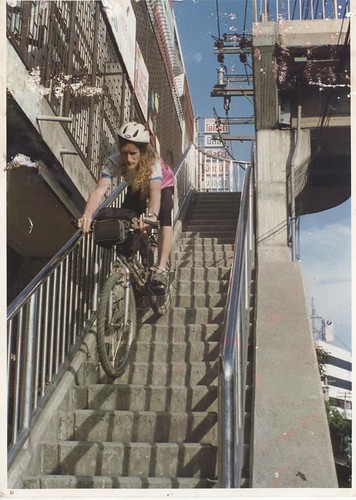
Bike Mike arrived in Kunming fourteen years ago after riding his bike from Guangzhou. The adventure that followed became legendary among travelers and kindred spirits everywhere. He hung around Kunming for a while before setting off on an epic journey that covered most of Yunnan Province, continental Southeast Asia and South Asia, all on bicycle. Then he returned to Kunming, all the wiser from his journey, and settled into the community here.

It is hard to find someone in this town who hasn’t been affected by Mike’s life here. He spent many years traveling around the area, and built a business upon the longstanding hemp traditions of Yunnan’s ethnic minorities. His clothing company produced limited edition hemp clothing lines for the likes of Quiksilver and Rip-Curl, as well as his own brand, People’s Hemp. Mike has also assisted various government departments and companies in the promotion of hemp industries and research. Upon his death, he had recently been reelected to the board of directors of the Hemp Industry Association, of which he was a longstanding and highly respected member.

But it was the personal touch that we’ll remember the most. Mike was always eager to take in wayward travelers, offering a place to stay, the run of the town and his unique insights into the people and places of Yunnan. I’m one of the many people he helped into the world of traveling by bike, and one of the many people who crashed on his couch. He always had a passion for this place, and took great joy in bringing others into his world. This is the end of a great chapter in Kunming history, though our city will always bear the mark of his presence, through the scores of people whose lives he touched.


I miss you bro.

Wednesday, August 15, 2007

Dream of a Red Mansion

Beijing Evening Press
Interestingly enough, Beijing has a pretty hot theatre scene, though linguistic and cultural barriers will probably keep it from ever taking a spot on the world stage. Last night I went to the closing performance of Zhang Guangtian's new play, Dream of a Red Mansion, which has generated more than a little controversy in Chinese cyberspace.

A hot topic in Chinese media is the upcoming production of the Chinese classic novel for television. The TV station announced that it would be holding "American Idol" style open auditions for the leading role, and the controversy over that has generated a lot of publicity for the film long before production even began. To add to the mess, the director has adamantly refused to work with any actor selected this way, setting off a big media fight. Most people in the culture scene, though, see this as just another publicity stunt, and they're probably right.

With impeccable timing, Beijing playwrite Zhang Guangtian knocked out a script for a play of the same name. A few months ago, I met him in an incident that almost immediately slipped my mind. A bunch of cultural and media folks were sharing drinks in the courtyard of the Jianghu bar, and we started talking about all of this Red Mansion controversy. He said he was working a script for a contemporary take on the novel, and had come out to smother his writer's block in cheap booze. People started talking about what the book meant to them, mostly talking about the poetry of the writing style and the intricately woven plot lines that play out in the Red Mansion, the ornate home of a large, wealthy Beijing family.

I gave him the western take on the book, which is that the book, as beautiful as it is, is obsessed with the petty intrigues of old China's moneyed elite, and is totally detached from the social reality around it, which, being a folk novel, was probably a deeply veiled social critique. I said that if the political climate were different now, one could make a great play by recasting the characters as the children of high level cadres and well connected captains of industry in latter day China.

Apparently he took my words to heart. I returned to Beijing to find that the play had generated a lot of controversy. The director saved me some tickets to see the play, and even posted a bluntly paraphrased version of our conversation in his blog, quoting me as the "American Imperialist" who had challenged him to take a radical and socially critical approach to the novel. My friends joked that I should go down there and demand my royalty check.

I finally made it to the play last night, and I have to say that it really rocked, though rumors of my influence were widely exaggerated. Of course a lot of it was over my head. Language issues aside (the script was a mix of Beijing slang and classical Chinese), it was a real post-modern work loaded with symbolism and inside jokes. A lot of the symbolism was just way out of my depth. Why was the novel's protagonist, Jia Baoyu cast as a woman, and what's all that stuff about her thrashing around in a fish tank being whipped by goons in raincoats? See what I mean?

Overall the play was excellent, and I wish it was still on so I could try another crack at it. The book's author, Cao Xueqin, is a down on his luck spoiled child of low level officials. It follows him and his wife in a witty dialogue as they hammer out the idea for the book. Between their dialogue are surreal scenes of the book's characters as they take shape. But it goes much further than that. The play is loaded with lampoons of the Chinese media and the state of Chinese society, where fame is shamelessly capitalized and sex is nothing but a cash-only commodity. The play is also a musical, as Zhang Guangtian got his start writing scores for movies, including Zhang Yimou's excellent film, Shanghai Triad.

The play is sexy, hilarious, audacious and confusing. Though I don't think anyone quite understood the whole thing, the audience was repeatedly thrown into fits of hysterics as they watched contemporary society dissected on the stage.

Unfortunately, a lot of the controversy was misplaced. Most of it centered on the director having the gall to reinterpret the Chinese classic tome. It's as if it was a crime to be an artist, or do anything but a verbatim staging of the original. And a quick scan over irate comments on the blogs shows that most of these people didn't even bother to see the play. Though China's cultural gurus are breaking some amazing ground, the general audience seems far behind.

But there are rays of hope. The house was packed and everyone was totally entranced. The cast was extremely talented. I was especially impressed by Guo Xiao, who brought his impressive skills in Beijing-style comedy talk into his rendition of Lin Daiyu.

All in all, I see some amazing potential in the Beijing theatre scene, and I plan to watch it as it comes into its own. And of course, I plan to keep stirring things up with my American imperialism...

Glossary:
戏剧: Xi4Ju4 - Drama
红楼梦: Hong2Lou2Meng4- Dream of a Red Mansion
张广天: Zhang Guangtian
高干子弟: Gao1Gan4Zi3Di4 - children of high-ranking cadres
美帝国主义: Mei3Di4Guo2Zhu3Yi4 - American Imperialism
争论: Zheng1Lun4 - Controversy

Tuesday, August 14, 2007

March On...

I was wandering around the net today and stumbled across a couple of old friends I’d like to tell you about.

Ed Jocelyn and Yang Xiao are living and breathing gods among China’s outdoor adventure community. The two of them have been retracing the steps of China’s famous Long March campaign all across the country, with nothing but what they can fit on their pack mules.

Along the way, they’ve met some amazing people and found some of China’s most stunning natural scenery. Of course, they’ve been taking pictures and writing about it the whole way, and I’ll give you the address in a minute.

They’ve also been working to document the histories of the people involved, and are some of the most informed people I’ve ever met on this subject. In fact, they were doing this long before Cui Yongyuan and CCTV, who did the My Long March event that we sponsored. They were the inspiration for this event, as Cui interviewed them months before he took his own march. To Cui’s credit, he admitted as much to me, if not publicly.

About the guys:

Ed Jocelyn is an Englishman who’s been living in China for years and speaks Chinese quite fluently. We actually often speak to each other in Chinese so as not to leave our Chinese buddies out of the conversation. I dig him, not just because he can get away with something like this adventure, but because I see in him the same interest and involvement in Chinese culture that I have, and he even takes it a bit further (thousands of miles further, to be exact).

Yang Xiao is a native Chinese all-around outdoorsy guy and top-of-the-notch equipment freak. He elevates the science of bag-packing to the level of quantum mechanics, and is far more comfortable in the wilderness than anywhere else. I’ve spotted him several times using his foldable camping cup and re-usable chopsticks even in big Beijing restaurants. This calls to mind the My Long March participants, who found that after marching for nearly a year, they became prone to car-sickness.

I met them in Beijing last year, and we’ve hung out a few times at my favorite Yunnanese restaurant in the city, Emmo’s Place, which is a big hangout for the hiking and jeeping crowd. The owner, Emmo, is a really cool Wa guy hailing from Lincang Prefecture in Southwest Yunnan. I have a post somewhere in the archives from when I went to his hometown to make a film. The restaurant looks just like a lot of backpacker hangouts in Yunnan, and serves up some great homestyle Kunming food. It’s also a great place to check out photos from the long march odyssey. A series I particularly like is photos of propaganda slogans painted all over the walls of the Chinese countryside. There’s really some funny stuff there, such as slogans warning against marriage by closely related mentally challenged people, as well as a lot of graffiti propaganda spoofs.

Anyway, the reason I’m telling you about these guys now is that they’re at it again, this time following the path of the 6th Division which went to some of the remotest parts of China. The two should be somewhere in eastern Tibet right now. Check’em out at www.newlongmarch2.com.

Thursday, July 19, 2007

The Young Priest

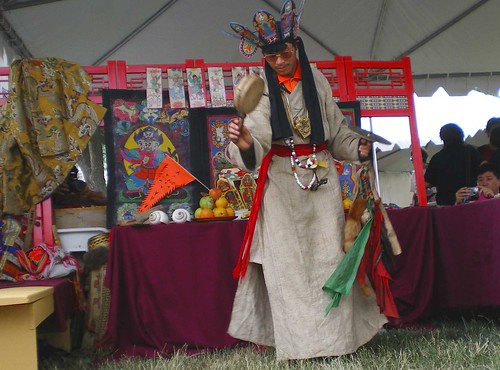
Another person from the folklife festival that I’d like to profile is He Xiudong. Mr. He is a Dongba, which is sort of like a priest for the Naxi People in northwest Yunnan Province. “Dongba” can be translated as “wise one”, as these people are more than priests, they are the carriers of their culture.

The duties, rituals and knowledge of the Dongba are passed from father to son, and at one time there were many active lineages of these priests. The rituals they perform are animistic in nature, making offerings to various gods and the spirits of nature. As the story goes, man and shv (spirits of nature) were half brothers, with man given domain over all domestic life, and shv given domain over all of nature. They used to live in harmony, but the shv became angered by man’s constant intrusions into the natural realm, and the wanton destruction of their property (ie trees, waterways etc). The chief role of the Dongba is to mediate between the people and the shv, so that angry shv will not cause earthquakes, storms, avalanches and other forms of natural mayhem.

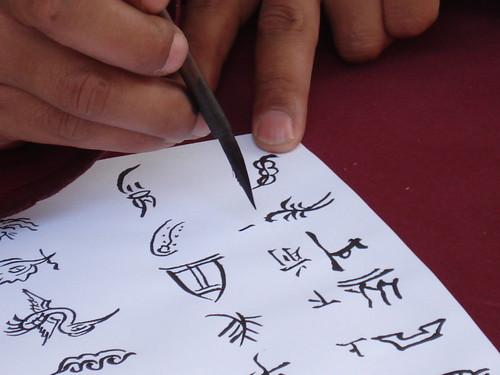
The other role of the Dongba is as the carrier of the Naxi People’s cultural knowledge. Their main tool in this role is the Dongba pictographic script, which is the only such script still in use today. Many of the Dongba scriptures write out the numerous steps of each Dongba ritual, but there are many other types of scriptures as well. Some contain medicinal knowledge, while others contain histories, myths and stories of the Naxi people. Traditionally, only the Dongba would learn the pictographic script. Thousands of the scriptures found their way to the library of Congress, where they are being digitally catalogued. You can view them here


And now, back to He Xiudong. Mr. He comes from a long line of Dongbas in a village in Tacheng, along the upper reaches of the Yangtze River. He is the 24th generation Dongba in his family, though he says this only traces back to the family’s arrival in the area, and it is impossible to say how long his family carried the tradition before that. The tradition skipped a generation with his father because of the Cultural Revolution. This happened to a lot of lineages, and many more had ceased for other reasons. There are only a handful of practicing Dongbas today.

He Xiudong learned the traditions of the Dongba from his grandfather and other family members of that generation. His family was once a very large clan of important Dongba, but now only he remains. His training was incomplete, as there wasn’t enough time, but he spends much of his time these days scouring the countryside for Dongba scriptures and practicing Dongbas. He also collaborates with the Dongba Research Institute, a government supported organization dedicated to the preservation of this tradition.

These days there are only a handful of Dongbas left, and almost all of them are in their seventies and eighties. One of the most striking things about He Xiudong is that he is only 27.

He came with us to the folklife festival to represent Naxi culture. He is not a performer, though we got him on stage a few times to sing a traditional drinking song. His main role was to perform a ritual offering at the festival, which he did several times.

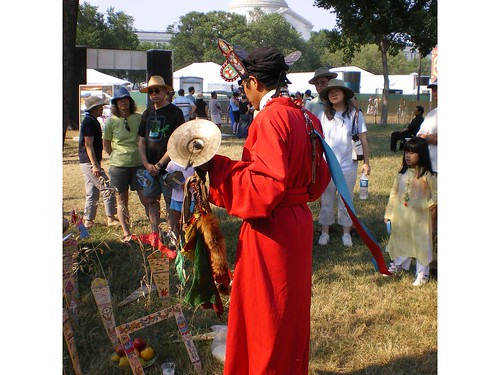
There’s an interesting story here. The original plan was for him to perform an ablution ceremony, where he blessed and ritually cleansed an area including a gate made of woven bamboo, through which onlookers could walk to become blessed. He sent a detailed list of the things he needed and instructions on how to prepare the area, but much of it was lost along the way. On the first day of the festival, we scrambled all over the place looking for everything he needed. When we were getting close, he looked at me and said, “where’s my chicken?” He figured it was common knowledge that a chicken had to be sacrificed for the ceremony. Anyone who is familiar with the state of affairs in America today knows that there’s no way the Smithsonian could get away with ritually sacrificing an animal on the mall every day for two weeks, respect for religion be damned. It took Mr. He quite a while to find a ritual that didn’t call for ritual slaughter, but he eventually settled for an offering to the shv, which could be done with rice and fruits.


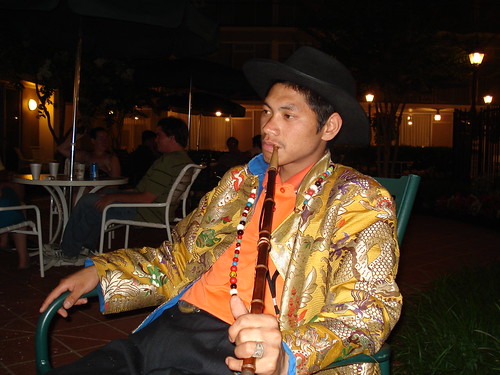
On and off-site, He Xiudong’s charisma quickly became the stuff of legend among festival participants and staff. He can’t speak a word of English, and even his Chinese is pretty shaky, but he made friends and fans everywhere he went. Sulking around in his robes, beads and black hat with a three-foot-long bamboo pipe hanging out of his mouth, people began to gather around him wherever he went. I did my best to translate for him as he interacted with the other people around him, but I also made an effort to make myself scarce whenever possible. He turned out to have an uncanny capacity for wordless communication, and everyone seemed to have more fun when I was gone.

By the end of the festival, people were lining up to wish him well and bestow him with gifts of beads, feathers, homegrown tobacco and the like. One guy even pinned a dollar to his robe in old-school New Orleans Mardi Gras style. There was a general consensus among everyone: this guy’s the shit!

I was touched by his ability to reach out, but even more so by his dedication to the traditions of his people. At a time when many Naxi youth are either diving into modern consumer culture or assisting in the commoditization of their own cultural heritage (I’ve actually seen a Budweiser poster with Dongba pictographs in Lijiang), he is staying the course, and reviving the spirit of a people against impossible odds

Saturday, July 14, 2007

Folklife: the Shangri-La Boys


Probably the best profile to start with is the Shangri-La boys, because so much of what happened at the festival started with them. The Shangri-La boys are a singing quartet from Diqing Prefecture, home to the recently dubbed “Shangri-La County”, the beautiful Tibetan area in northwest Yunnan that is hoping to attract more tourists by masquerading as the mythical land of Lost Horizon.

The quartet is made up of two Tibetans, Lurong Nongbu and Damo Luzhuo, as well as two Lisu men, Feng Yuehong and Yu Minghui. They sing, dance and play their fiddles to the traditional sounds of their hometown. They also harmonize really well in a fashion that led us to dub them the “barbershop quartet”.

They do a lot of great traditional stuff, especially paired off by ethnic group, but when you get the four of them together they’ve got this crazy, syncopated song and dance thing that is at once so funny and so cool that it steals the crowd.

These four long-haired guys in Tibetan robes and hemp vests were the center of attention on-stage, off-stage and at the afterparty, among other places. They loved having a good time, drinking and carrying on by the hotel swimming pool, pounding out beats on the table as they belted out drinking songs, and handing out beer and cigarettes to any bystanders who lingered for more than a minute.

This was the scene late one night early in the festival when the first true cultural exchange of our trip began. The boys had been singing a soft drinking song when three people approached our table, the usual one next to the pool. They asked me to translate, saying “we are from the Virginian tribes; we love your music, and my friend here would like to honor you with a drum song.” “Hao!” was the answer. Yunnan folks are always down for a good time and always happy to make a friend. Then one of the three stepped forward with his hand drum, and belted out a beautiful song from his people. Thus began a nightly exchange of stories, histories and especially music and dance, between the indigenous peoples of Yunnan and the Powhatan nation of Virginia. That was one of the coolest things to happen at the festival, but a deeper description of it will have to wait until a later installment.

What you need to know is that this was the formation of our icebreaking ‘cool circle’ that hung out every night and welcomed various festival participants and staff to come out and party with us every night. At that table, we communed with musicians, storytellers, craftsmen and professional organizers from all over the place, and that’s what made the festival so cool. The daytime performances and audience interactions were of course wonderful, but it was the nightly hotel social with its two dollar beers that we looked forward to every day. Some of us joked that the festival on the mall was just a façade get funding for the true festival, which was the behind-the-scenes party among folklorists from around the world.

The Shangri-La boys, with their scraggly charisma, became an anchor for these parties. The parties were held by the cool people at the Folklore Society of Greater Washington, who brought their guitars, basses and banjos to jam out with the festival participants every night. That was really cool, listening to old-time mixing with the sounds of Northern Ireland, but after a few drinks, the Yunnan crew would always steal the show, belting out Yunnan mountain songs that filled the room. Of course we started out simply for our own entertainment, but soon the whole room was applauding the Shangri-La boys, and the old-timey musicians were grimacing from the other side of the crowd.

The Shangri-La boys are already big stars in their hometown. They are the unofficial mascots of Shangri-La, performing at every cultural event in town. They also travel a lot, performing in China’s major cities and various countries on the outside. I have a lot of respect for these guys. Not just because we made friends and had such a blast, but because of what they are all about. These young men are from traditional cultures that have been fading away in the face of modernization and tourism. They never made a conscious decision to pursue a profession in music, they just lived the life. Here they were, young men from their communities carrying on the musical traditions of their people, and even making it look cool as they’re heaped with acclaim from the outside world. If they party back home like they did in DC, which I’m sure they do, then you can safely bet that there is a whole generation of young kids in their community who want to be just like them. That is how culture thrives.

Back in the Jing

So now I’m back in Beijing after a few weeks in the motherland. It was good to be back. I enjoyed the hot but otherwise beautiful weather, staring at the clear blue skies, and being surrounded by trees. I came to enjoy the civility of things, what with people waiting in line and opening doors for each other. I loved the fast, unblocked internet and the tasty, fattening American pastries. To say the very least, I made the most of my trip back.

The funny thing is, it didn’t really hit me until I got off the plane. Though traveling always sucks, my escape was one of the smoothest ever, everything neatly laid out before me and proceeding in an orderly fashion. I even managed to score a whole row of empty seats in economy plus. I spent the better part of my thirteen hour journey horizontal, and the last time I did that was just after 911, when no one in their right minds would want to fly (except me).

It all began as we started getting off the plane. I could see the overseas Chinese around me going through a mental transition, steeling themselves for the ordeal lying ahead. We were all doing it, reawakening our China selves, the personas that are discomforting to think about in the aura of happy-go-lucky America.

Ahead of us lay the long sweaty customs lines, the long wait at baggage, and then the gateway. Once you get to the gateway, there’s no turning back. The people, bags in hand, flow together towards the claim exit and face the massive. Even before the line reaches it, people are beginning to complete their transformation, beginning to jostle for a strategic position ahead. Out there you can already hear the massive, the throngs of people swarming around the exit, waiting for loved ones, clients and tour groups. Their numbers are so strong that we have to fight our way past them.

And there I am, tensely steering my overloaded baggage cart between clusters of people stopping to stand in the most inopportune places, and playing chicken with other oncoming travelers. The crowd there, the likes of which are only seen in America during big summer gatherings like Independence Day, is just business as usual at the Beijing airport.

The next step in the back-in-Beijing ritual is to park the cart by the door and grab a smoke. It’s not nearly as hot as I expected it to be, but the dirty humid air gives me a sticky embrace right away. It’s mid-afternoon, but the sky looks like evening in winter. Everything is gray and dim, the sun blotted out by clouds and smog.

After my dose of nicotine, I’m ready for the next part of the ordeal. I get in line behind a few hundred people to wait for a taxi. I swerve my cart side to side as the line progresses to cut off the people wanting to sneak ahead of me. I hold my elbows out as far as I can to let everyone know that I’ve played this game before. We all move forward in tense staccato steps to hold formation and finally I’m assigned a cab. Now the rest of my journey becomes passive, as it’s the driver’s job to deal with identical conditions on the roads.

My driver’s good at that, though scary as hell. He zips around buses and into the emergency shoulder (which is just as packed as all the other lanes), blaring his fancy reverb-effect horn as he fights his way to the fourth ring road. Of course, I’m already back into China-self, and I hardly take notice of the chaos outside as I glance up from my book (High Fidelity by Nick Hornby today).

Last night, or at least the last time it was dark for me, about 36 hours ago, I had a bunch of my friends out to a local bar. I was psyched to have them all together before leaving, and many of them, all old friends, had never met each other before. One question they asked a few times was whether I was excited to go back ‘home’. I drew a blank at first, because the last two weeks had so utterly ripped me from the China setting that the whole China thing seemed like a dream. Even though I was about to leave in a few hours, I hadn’t really put any direct thought into it. One of the few perks about running all over the place is that you can slip into a new setting right away, and let your consciousness get absorbed in the surrounding reality. I knew that I’d have to get back to China to know what I thought about going back to China. And now here I am.

The Beijing welcome was so typical and complete that I’m right back in the zone. It’s nothing to be excited or nonplussed about, it just is. It’s going back to my life, picking up what I put on pause and continuing like nothing ever happened. Besides, I was only gone for two weeks.

The Beijing welcome, as harrying as it was, is just a part of what makes Beijing whole. You can’t just take the most enjoyable and stimulating things about it in isolation. None of it would be complete without the blunt force that its reality applies to your head at every turn. Though I often have feelings like “if I have to live in a big city, why can’t it be a nice clean one with lots of trees”, I want to keep riding this Beijing thing for a while and see where it takes me. I still have lots of fun to have yet, and this last trip once again affirmed for me that I haven’t become utterly dislocated from the US.


Web Page Counter
XBox Online Game Rentals