On Christmas Eve I was saddened by the news that my favorite café in Kunming, Salvador’s Coffee House, fell victim to a bomb attack. Luckily, none of the patrons or staff were seriously injured, though the bomber died of his wounds later that day.
In my nearly nine years in Kunming I have always viewed the city as a safe place, much safer than most American cities, and safer than many Chinese cities as well. The idea of a bomb attack that apparently targeted foreigners still seems ludicrous.
Salvador’s has been an important part of the community, and was heavily frequented by locals and foreigners alike. The American owners are friendly and easygoing, and have a very enlightened approach to business’s responsibility to the community.
The specter of foreign-targeted violence is very unsettling, as are a few other things that I’ve recently noticed.
First, and probably the most baffling, is that no major international news outlet (with the exception of South China Morning Post, based in Hong Kong) has picked up the story. Why would that be? It was a bomb, someone died, the city was recently victim to two bus bombings that remain unsolved, and foreigners were targeted in a region that is heavily dependent on international tourism. THIS IS A STORY!
I have a few theories as to why they haven’t picked up on the story yet. The first is that the bomb failed to produce a large body count. Sensationalism sells. The second is that the incident fails to fit into the “story-arc paradigm” that so dominates the international press these days. When the bus bombings took place, you had tons of reporters writing things like “China faces growing security risks during the approach to the Olympics”. Reporters were also quick to point their fingers at a farmer protest in southern Yunnan, because newsworthy stories can only be understood in light of other events that made the news. With the Olympics over and things calming down in Tibet, this incident is rather hard to explain. The third theory is less odious, but doesn’t let the international media off the hook. The bomb hit Salvador’s on Christmas Eve, when a lot of newsdesks are stripped down to a skeleton crew. By the time they notice that news actually happened during their time off, the story will be too old to report. Regardless, every China desk should be ashamed for failing to find and report this story.
Another unsettling development is that even before the bombing, Kunming was feeling less and less like a safe city. Two buses were bombed at morning rush hour earlier this year. A man was recently shot by police snipers after a five hour hostage standoff in a Kunming Carrefour. I myself was present at the Box, a bar near Salvador’s, when some drunken men stormed the place with crowbars. I also recently witnessed a massive gang fight in Kunming’s disco district which local security guards and police were helpless to stop. What the hell is going on here?
The Box incident, though paling in comparison to the recent terrorist attacks (there, I said it), is an interesting case. When police were summoned to the scene, they actually caught the guys coming back to finish the job. Nevertheless, the young men were questioned and released. Then an officer came in and proceeded to grill us about why these people (whom we’d never seen before) would be so mad at us. After releasing our assailants, he was basically trying to lay the blame on us. Perhaps he was angry that we had disrupted his drinking session. One of us noticed that he was not wearing any identification, which is a violation of police procedure. We asked for his badge number, and he threatened to arrest us for not carrying passports (surely a much worse offense than attempted assault with a crowbar). He eventually conceded only that his surname was Yang, and that he is an officer at the local Wenhua Xiang police station.
I am very familiar with that police station, as it is right next door to Kunming’s largest purveyor of pirate DVD’s. I wonder if perhaps this kind of attitude towards policing might be contributing to the growing atmosphere of lawlessness in the city.
I’m rambling. Back to the unsettling things. The most recent unsettling development is taking place on Gokunming.com, an excellent Kunming expat blog that has been following the Salvador’s attack and doing a good job. At the beginning, the comments section was an outpouring of sympathy for the people at Salvador’s. This seems to be quickly degenerating into a flame war, as shameless ultranationalists are pointing the finger at foreigners. One comment told all foreigners to go home before “bringing more danger to our country”. Another told us all to “fuck off and die”. I really wish these people would realize that they’re not doing their country any favors. If they really cared, perhaps they would direct some of that anger at the people who put so many innocent lives at risk.
That is my rant. Now to the important stuff:
I love Salvador’s and all of the people there. I am overjoyed that they are all okay, and I can’t wait to go back down there for a cup of excellent coffee as soon as the place reopens. My heart goes out to their family members who right now can only worry from the other side of the world. Let’s all stay positive.
Friday, December 26, 2008


Tuesday, November 04, 2008
Friday, October 24, 2008
Supergirl Li Yuchun and her 50 cent Army (With Update at Bottom)
I've been following an interesting exchange recently on Danwei . I'm sure that everyone is familiar with the Chinese netizens who flood web postings about China with all kinds of comments, usually 'defending the nation's honor' against perceived bias and whatnot. Some of these people are believed to be employed by the Chinese government in what one sinologist terms the '50 cent army'. He believes that these people are paid small amounts of money per post they make supporting certain stances held by the party. Of course, the majority of these people are not in anyone's employ, but the theory makes sense. Check out any Economist article on China to see what I mean.
The interesting thing is, this is a huge phenomenon in the Chinese netsphere. Chinese celebrities have their own armies of netizens, paid and unpaid, to shower them with compliments and flood negative coverage with scathing criticism. One of these, I found out yesterday, is Supergirl Li Yuchun.
An article about a recent listing of Beijing heroes by Time Out Magazine has been flooded with dozens of comments that basically heap her with praise. What makes it interesting is that Danwei is a hangout for people who constantly scrutinize Chinese media, whether it's for a hobby, professionally or as academic research. It's like a mycologist getting a fungal infection.
Anyway, it's worth taking a look. In the meantime, I am currently hiring conscripts for a 50 cent army of my own. Apply within...
The interesting thing is, this is a huge phenomenon in the Chinese netsphere. Chinese celebrities have their own armies of netizens, paid and unpaid, to shower them with compliments and flood negative coverage with scathing criticism. One of these, I found out yesterday, is Supergirl Li Yuchun.
An article about a recent listing of Beijing heroes by Time Out Magazine has been flooded with dozens of comments that basically heap her with praise. What makes it interesting is that Danwei is a hangout for people who constantly scrutinize Chinese media, whether it's for a hobby, professionally or as academic research. It's like a mycologist getting a fungal infection.
Anyway, it's worth taking a look. In the meantime, I am currently hiring conscripts for a 50 cent army of my own. Apply within...
Update: the 50 cent army seems to be taking it easy with Danwei. I estimate they've only made about 70 posts since the story started last week. That's understandable as the article wasn't negative, and it was, after all, in English. While I was playing around in the postings, I came across a woman named Lili who is researching this specific phenomena. She shared a very interesting anecdote:
Actually, I have seen these kinds of wrecks many times. The worst time was Li's haters attached her fans' Baidu Post (BBS or public forum), using program generated curse comments. The auto-comments could reach 60-100 pieces per minute. Her supporters learned to use the same strategy to defend. Eventually, they drove Baidu servers, the biggest internet engine in China, to collapse for a few days.
That's just awesome.
Wednesday, October 08, 2008
What's Going on Here?
Note: Update at bottom
I just had an amazing bike trip through Yunnan for the holiday, which I'll hopefully get back to soon. Today, though, a little bit about the Chinese art market.
It's nearly impossible to estimate the size and health of the global art market, because so much of its volume is carried out between private individuals and galleries, which are all in private hands. The auction market is considered a barometer of market health, but it is a slippery one, because as some say, "it's only the tip of the iceberg". We get good figures from them because many of the big auction houses are public companies, and because the auction events are always highly publicized, but no one is even willing to guess what fraction of the total art market their sales represent.
Nevertheless, we have to keep feeding the habit, as much of the market watches what happens at these auctions and adjusts prices accordingly. This has especially been the case in China, where so many of the collectors are speculators, and there are rampant rumors of price manipulation through insider bidding. China's art market has been soaring in recent years as Chinese private collectors and finance have jumped in, where only a few years ago the vast majority of Chinese contemporary collection was done by foreigners.
As I watched with the Puer tea market and again with the Chinese stock market, many of these new entrants seemed to believe that the market for their particular good was not subject to the laws of economics. Works by top flight artists are now selling in the millions of dollars, and efforts by newcomers to discover the next big thing have driven up the prices of much less established artists, even ones who haven't yet graduated from art school. Though I think that in the long term Chinese art will continue to be very strong, we're definitely in for some kind of correction, basically a smack in the face to remind people that the laws of physics still apply.
So I wasn't too surprised to see Sotheby's fall auction in Hong Kong fizzle. We are, after all, in the midst of a global financial crisis. Though top artists like Zhang Xiaogang (my fave) and Cai Guoqiang had pieces that sold for over USD 2m, almost a quarter of the lots failed to sell, and the ones that did only clocked in at the low end of their estimates. I think that this is a good thing. We need to start weeding out those artists who see painting as merely a license to print money, and those galleries and collectors who appraise artists solely based on their potential to go up in price. That makes room for true artists to do what they do best: art.
The confusing thing though, is the reaction I've seen on the internet. The auction results have of course garnered a lot of media attention, being written up by Wall Street Journal and all of the art websites. But one site in particular caught my attention. A recent newcomer, Artintern.net is a well designed bilingual website on the Chinese art scene. The Chinese coverage is excellent, and their English writing is better than a lot of other bilingual sites which have popped up recently. So I was surprised to see yesterday the headline, in English, "Chinese Contemporary Art Sell of Sotheby's (sic) is Still Strong". It cited another website, Artzinechina.com, as saying that sales still remained strong, citing only the high prices that did make the cut, and not one word about the failed lots. Their Chinese mirror site got it right though, citing a "disappointing performance". What's going on here? Was it a bad editing job, or are something else? I checked Artzine, which says on the top of its news page that the Sotheby's auction had a "surprisingly poor showing". One of the first sentences that Chinese students of English learn to say is "My English is very poor", so I doubt that they could have misread the article.
Update: Artintern has caught the mistake, and now has not one, but two articles about the poor Sotheby's results.
I just had an amazing bike trip through Yunnan for the holiday, which I'll hopefully get back to soon. Today, though, a little bit about the Chinese art market.
It's nearly impossible to estimate the size and health of the global art market, because so much of its volume is carried out between private individuals and galleries, which are all in private hands. The auction market is considered a barometer of market health, but it is a slippery one, because as some say, "it's only the tip of the iceberg". We get good figures from them because many of the big auction houses are public companies, and because the auction events are always highly publicized, but no one is even willing to guess what fraction of the total art market their sales represent.
Nevertheless, we have to keep feeding the habit, as much of the market watches what happens at these auctions and adjusts prices accordingly. This has especially been the case in China, where so many of the collectors are speculators, and there are rampant rumors of price manipulation through insider bidding. China's art market has been soaring in recent years as Chinese private collectors and finance have jumped in, where only a few years ago the vast majority of Chinese contemporary collection was done by foreigners.
As I watched with the Puer tea market and again with the Chinese stock market, many of these new entrants seemed to believe that the market for their particular good was not subject to the laws of economics. Works by top flight artists are now selling in the millions of dollars, and efforts by newcomers to discover the next big thing have driven up the prices of much less established artists, even ones who haven't yet graduated from art school. Though I think that in the long term Chinese art will continue to be very strong, we're definitely in for some kind of correction, basically a smack in the face to remind people that the laws of physics still apply.
So I wasn't too surprised to see Sotheby's fall auction in Hong Kong fizzle. We are, after all, in the midst of a global financial crisis. Though top artists like Zhang Xiaogang (my fave) and Cai Guoqiang had pieces that sold for over USD 2m, almost a quarter of the lots failed to sell, and the ones that did only clocked in at the low end of their estimates. I think that this is a good thing. We need to start weeding out those artists who see painting as merely a license to print money, and those galleries and collectors who appraise artists solely based on their potential to go up in price. That makes room for true artists to do what they do best: art.
The confusing thing though, is the reaction I've seen on the internet. The auction results have of course garnered a lot of media attention, being written up by Wall Street Journal and all of the art websites. But one site in particular caught my attention. A recent newcomer, Artintern.net is a well designed bilingual website on the Chinese art scene. The Chinese coverage is excellent, and their English writing is better than a lot of other bilingual sites which have popped up recently. So I was surprised to see yesterday the headline, in English, "Chinese Contemporary Art Sell of Sotheby's (sic) is Still Strong". It cited another website, Artzinechina.com, as saying that sales still remained strong, citing only the high prices that did make the cut, and not one word about the failed lots. Their Chinese mirror site got it right though, citing a "disappointing performance". What's going on here? Was it a bad editing job, or are something else? I checked Artzine, which says on the top of its news page that the Sotheby's auction had a "surprisingly poor showing". One of the first sentences that Chinese students of English learn to say is "My English is very poor", so I doubt that they could have misread the article.
Update: Artintern has caught the mistake, and now has not one, but two articles about the poor Sotheby's results.
Wednesday, September 17, 2008
Gen Dequan
Gen Dequan, the famous Dai folk musician, passed away last night of an apparent brain hemorrhage. He was a master of the Hulu, a reed instrument fashioned out of drinking gourds which is popular among the Dai and many other ethnic groups throughout Yunnan and Southeast Asia. He was fifty years old.
Known as King of the Gourd, Gen Dequan was instrumental in popularizing the folk music of the Dai people, and making their music a household name throughout China, synonymous with the cultural diversity of Yunnan Province. Throughout his career he toured many cities and countries, sharing the musical traditions of his people.
I was fortunate to know him. We first met on the Yunnan Revealed tour in 2005, when I was tour manager and he was a performer. He came again with us to the Smithsonian Folklife Festival in 2007. He was a good man and a phenomenal musician.
Tuesday, September 16, 2008
Virtual City, Empty Fortress
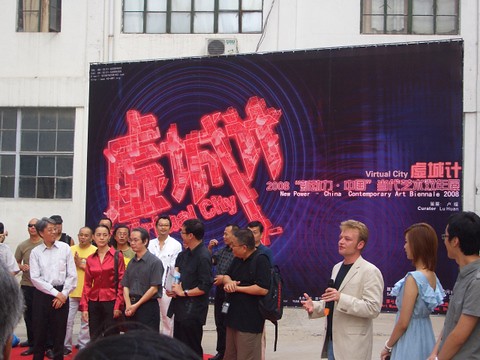
Hosting the opening ceremony
Last weekend I made a journey to the virtual city. Though it doesn’t really exist, the portal to this city was on the west side of Shanghai. Shanghai was boiling with artists that weekend that flocked there for the three major art expos that happened last week. Though the city definitely plays second fiddle to Beijing in the China art scene, this time it was host to probably the most important art happening of the year with thousands of artworks and dozens of satellite exhibitions.
Virtual City was one such satellite exhibition. It was conceived by Yuan Gong, Shanghai real estate mogul-turned supersized art patron. He recently established the Yuan Gong Art Museum, Artra Space and Yuan Gong Art Organization at a complex of buildings on Gubei Lu near the old Hongqiao Airport. He’s been tossing around money and doing some really cool stuff over the past few years.
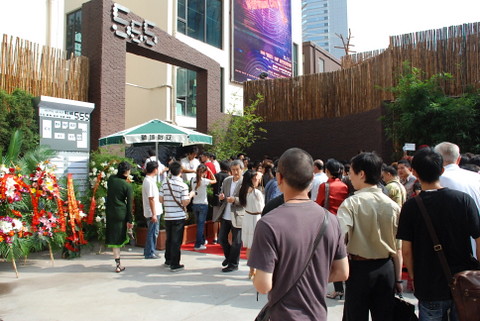
Visitors descend on the Virtual City
The concept behind Virtual City was to manipulate the environment in a way that created an impossible space, one in which the physical environment interfered with reality in absurd ways, and in which virtual reality expanded the experience into another dimension. The complex was filled with installation, sculpture and new media works by over fifty artists, and the complex itself was transformed by a web of obstructions and labyrinths which made navigation all but impossible.
I was there to serve as one of the hosts for the opening, as well as general translator. I had friends in the show and friends who came out to see me, and between them and the needs of the event, I was running around like a chicken with its head cut off. The obstructions created by the space and the massive crowds – especially around the installation with a live exotic dancer on a mechanically bouncing bed – made the day next to impossible. I was constantly cursing the labyrinths and hidden stairwells as I ran back and forth, and I barely had time to look at the artworks. But of course I knew that this feeling was exactly what the curators had intended.

One of the creepier works on display
I did have time to see some of the stuff, though. Unfortunately much of the work would have been unremarkable if it weren’t for the stellar presentation. The best artwork of all was the exhibition itself. Two pieces, however, stood out. One was “Sounding off for 5.12”, an interactive media installation about the May 12th Sichuan Earthquake by an artist whose name escapes me. A crushed truck had been removed from the wreckage of the earthquake and shipped to the exhibition space, where it was placed in a cavity in the floor. It was covered in stripped down speakers and lights, and more importantly, an array of motion and sound sensors. The speakers and lights reacted to the sensory input from the audience, and emitted sounds and lights accordingly. The most striking thing about this installation was the sound. Two separate sounds were recorded. The first was the sound of every car horn, factory whistle, siren and other noisemaker in the country, which were sounded off in unison during a nationwide day of mourning for the nearly 70,000 victims of the earthquake. The second sound was that of survivors hammering away at the ruined buildings looking for scrap metal they could sell to supplement their food rations. These were sounds of solidarity, sounds of despair, and sounds of the invincible human spirit. I’d like to spend some time alone with the piece some day.
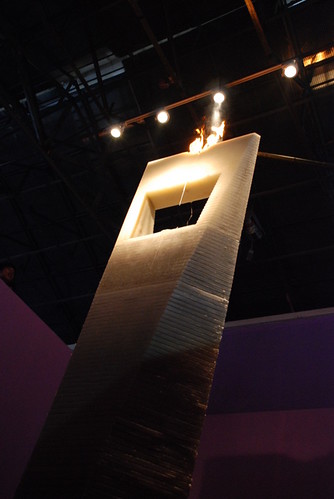
Cang Xin's tower
The second piece that struck me was a three-story scale model of Shanghai’s new World Financial Center, the tallest building in China, in wax. It was a perfectly executed replica by artist Cang Xin and his crew of workers. The building was in an atrium inside one of the compound houses. As it towered over the other artworks and by the various balconies, it was being slowly melted by a massive torch suspended over the artwork. I always have trouble reading into Cang Xin’s works, but there’s never a dull moment with that guy. In fact, though it was much different from a lot of his other work that I’ve seen, I knew it was his without even looking at the label. The first thought that ran through my mind was “only in China”.
Before long I was pulled away to catch a really cool experimental dance piece directed by Wen Pulin, followed by an academic forum. The original idea was that I would translate for any foreigners who wished to attend, but they were all lured to other exhibitions by the free booze. Since I was seated at the main table, it would have been rude to leave, and besides, these were some of China’s top critics. I had translated many of their essays, and was keen to get to know them a bit better. The forum was quite interesting, because on top of some of China’s best critics and curators, there was also a philosopher, Philip Zhai, who happens to specialize in the philosophical concepts and issues of virtual reality. He had captivated our dinner and drinking session the night before, and did the same with his opening remarks at the forum. He argues, among other things, that as virtual space becomes a larger part of our lives, it may one day become more important than the real world, and when that happens, the virtual will become the real, and the real, virtual. Interesting guy.
Halfway through our forum, the speaker was interrupted by the sound of approaching sirens. Someone joked that maybe Cang Xin’s wax tower had set the building on fire, and we all laughed. The forum continued for another hour or so, during which time I got a text message from a friend, San San, Ms 33, saying, “We’ve been evacuated to the parking lot and are trying to decide where to go next. When are you finished up there?”
San San is an attractive young artist and event promoter that I met on a previous trip to Shanghai. She had a piece on the roof of the same building as Cang Xin’s piece. Her installation was a cluster of small structures covered in clippings of newspaper headlines and other media info, in a statement about how much media shapes our world these days. She had kept a fire extinguisher next to the work as she put it together all week, just for safety’s sake. When she finished the artwork, she decided that she liked the fire extinguisher, and also covered it in newspaper, placing it in the center of the installation.
That made her the guardian angel of the virtual city. Sometime in the afternoon, the torch above Cang Xin’s artwork managed to burn through the ceiling, surprise surprise. Falling embers ignited the entire wax tower, which promptly collapsed and sent flames flying everywhere. My good friend, Huang Zheng, true to his style, helped evacuate the audience members, and joined with Cang Xin in trying to put out the flames; a job made that much easier thanks to San San’s fire extinguisher. The two men were the last to leave the building just as the fire brigade arrived.
Imagine the firefighters’ rage when they found they had to navigate a labyrinth to get to the fire site and that there were no evacuation routes. Our forum was in a building on the other side of the compound, oblivious to the whole thing. When we finished the discussion, we were astonished to find that the labyrinths, the obstacles, the entire virtual city had disappeared without a trace (except for maybe a smoldering blob of wax) on orders of the fire brigade. I congratulated the curators on a job well done. They had succeeded in creating a truly impossible space. Had it ever really existed in the first place?
Oh and by the way, San San retrieved her fire extinguisher. Maybe one day when she makes it big we can put it in a museum next to Duchamp’s urinal.
Sunday, August 31, 2008
A Little Shaky
I was working away yesterday when I noticed the ground was shaking. More appropriately, the building was shaking. I'm on the top floor of a building on a hill, so things were shaking quite a bit. It turns out a 6.1 quake hit the town of Panzhihua yesterday, just across the border in Sichuan. This is in a different spot from the one that hit May 12th. There are reports of some casualties and collapsed buildings over there. It's too bad. There are a lot of poor, remote areas in the hills around the area, and Sichuan's still having a tough time in the rescue effort from the previous, more deadly quake.
For everyone with friends out here, Kunming is fine. No damage, as far as anyone has heard. The ground shook again the same time today, but less intense. This is getting old.
For everyone with friends out here, Kunming is fine. No damage, as far as anyone has heard. The ground shook again the same time today, but less intense. This is getting old.
Tuesday, July 22, 2008
Damn Good Wine
Sunday was a particularly fulfilling day. I had given up yet another weekend to my translation work, cramming for two major deadlines. Lo and behold I sent out the documents at five on the dot, a time that means less and less when you’re working at home.
Usually the weather in Kunming is absolutely beautiful while I’m holed up inside at work, and turns to sh-t whenever I have free time. On this day, however, it had been raining all day, but things were just quieting down as I finished the last few sentences.
It’s been a while since I’ve had some quality time on the roof. I grabbed some wine leftover from the night before and moseyed out into the garden with Orhan Pamuk’s “My Name is Red”.
It was as if the clouds had parted just for me. To the east was a low ceiling of grey rainclouds, no doubt still relieving themselves on all my friends over there. On the other side, the Western Hills were dwarfed by a massive, multi-tiered cloudbank. Bathed in the magical golden Yunnan sun and seeming to billow and stack up endlessly, they were definitely renaissance clouds, capturing all the glory of the creation forever on the ceiling of some rich Venetian trader. And right above me was a flawless, endless blue.
Captivating as it was, my Turkish murder mystery just couldn’t beat the weather for pure entertainment value. I grabbed my glass of wine and wandered off to the western edge of the garden. Gnats and flies must have been lured out by the fresh moist air, because I was presented with the spectacle of thousands of dragonflies on the prowl. They filled the sky over the tiny, lush garden valley that the next door slum carved out of the endless rows of housing complexes. If I were down there, I would be able to watch the children chase the dragonflies with nets. Tie a hook on the back of a dragonfly and you have an amazing, living, flying fishing lure to take with you to the lake.
But up here there was a different kind of hunt going on. Sparrows and other small birds, attracted by the buzz of wings, were hunting down the dragonflies, pulling off effortless war maneuvers. I’ve always wondered why, here in the middle of China’s most thriving ecosystems, I only ever saw slum birds. Maybe it’s just too nice out there in the hills.
There is another kind of bird in the picture. Several of my neighbors raise flocks of pigeons on the rooftops. Today there were two flocks out, flying in tight circular formation around the waving flags of their keepers. As I sat back down to my book, the garden was periodically swept by the shadow of these pigeons as they flew overhead. Once I master the pigeon language, I’ll thank them for never shitting on me after so many flyovers.
I glanced back at the massive golden cloudbank over the Western Hills. It was so distant and expansive, it looked almost like a giant movie backdrop. I spotted a black dot in front of one of the clouds. A bird? A plane? No, it’s an old man. In my American youth, kite flying was a father-son sport, where the father would toss the kite in the air and the son would run around seeing how long he could go before the kite hit the ground or caught a tree. In China, kite flying is about old men in the park effortlessly launching their kites into the stratosphere. On any good day one can spy tiny clusters of black dots hovering motionless over the city.
Seeing all this beauty at once reminded me why I had missed Kunming so much during my dust-covered days fighting through the social ladders of Beijing. It reminded me why I call this place home, why I had quit my corporate job and come back here to live the quiet life of a translator.
I leaned back, listened to the birds overhead and enjoying the warmth of the afternoon sun on my back, and I thought, “damn, that’s some good wine.”
Saturday, April 19, 2008
A Word of Optimism
Let's go back to take a look at what I was talking about in my last posting. I still feel that a bit of caution is necessary in dealing with the Chinese art market, but things are still going well. The Sotheby's auction actually went quite well, and prices stayed quite high. One example, Zhang Xiaogang, saw a single painting from his much sought after Bloodlines series sell for HKD 42 million.
I still see a bubble looming on the horizon, but whatever happens, Chinese art is here to stay. One of the biggest reasons for optimism is that the Chinese themselves are starting to acquire a taste for art. We're starting to see more local collectors, and they're more than just a bunch of successful artists buying each others' works. That's a good sign, as the political situation in the past allowed Chinese contemporary art to explode without causing even a blip on the local cultural radar. Foreign collectors were snapping everything up, and most of the locals were none the wiser. We're even seeing homegrown corporate and institutional investment in art, thought that's still in its infancy. One of the most promising new developments is the arrival of homegrown non-profit art organizations and events, which is absolutely necessary if we're to see a renewal of dialog between artists and the society around them.
The scene in general is slowly growing beyond a simple market organization. Beijing's 798 Art District is now home to two large art centers, the Ullens Center (founded by a big-time European collector) and the Iberia Center (founded by the International Art and Culture Foundation of Spain). Though foreign, these two institutions are more focused on exhibitions, education and outreach than pure sales. In fact, they're not selling, at least not the stuff they exhibit. Overall that's a good thing, but the fact that 798 and a lot of the other art districts are located on the edges of this sprawling city guarantees that the Chinese art scene will remain an insider game for a long time.
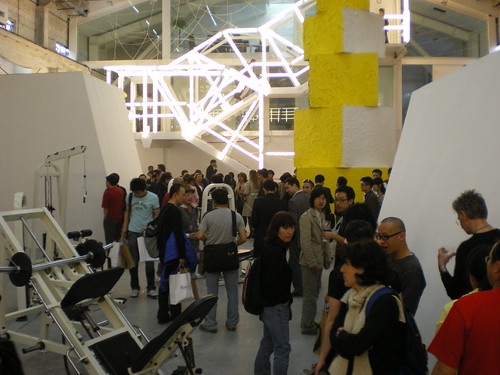
opening day at the Iberia Center
I was quite impressed the other day when I attended the Iberia Center's opening exhibition. They've rounded up a lot of talent, leaning towards younger, more adventurous curators and organizers. Another good sign is their film center, which will house a media archive, studio and screening room for independent documentary film. To make this happen, they've tapped Zhang Yaxuan, who is definitely one of the most knowledgeable and active figures on the scene. I met her a long time ago at Yunfest, and I'm really glad to see that someone's willing to give her the money and resources she needs to take things to the next level.
There are still a lot of problems with the art scene, and I could make a long, boring list of them (and don't worry, I will keep ranting in the future), but I think they all boil down to a single problem, which is that they've never seen a bubble. Bubbles happen all the time in New York, London and Paris, and eventually people pick up the pieces and wise up a bit. It's a necessary process that weeds out the bad seeds every once in a while. But the more I look into it, the more I'm convinced that this run still has some legs. There are a lot of collectors who are just getting into the market, and a lot who haven't made it out yet. Just as with everything else in China, everyone wants a piece. Hopefully things won't get too out of hand.
I still see a bubble looming on the horizon, but whatever happens, Chinese art is here to stay. One of the biggest reasons for optimism is that the Chinese themselves are starting to acquire a taste for art. We're starting to see more local collectors, and they're more than just a bunch of successful artists buying each others' works. That's a good sign, as the political situation in the past allowed Chinese contemporary art to explode without causing even a blip on the local cultural radar. Foreign collectors were snapping everything up, and most of the locals were none the wiser. We're even seeing homegrown corporate and institutional investment in art, thought that's still in its infancy. One of the most promising new developments is the arrival of homegrown non-profit art organizations and events, which is absolutely necessary if we're to see a renewal of dialog between artists and the society around them.
The scene in general is slowly growing beyond a simple market organization. Beijing's 798 Art District is now home to two large art centers, the Ullens Center (founded by a big-time European collector) and the Iberia Center (founded by the International Art and Culture Foundation of Spain). Though foreign, these two institutions are more focused on exhibitions, education and outreach than pure sales. In fact, they're not selling, at least not the stuff they exhibit. Overall that's a good thing, but the fact that 798 and a lot of the other art districts are located on the edges of this sprawling city guarantees that the Chinese art scene will remain an insider game for a long time.
opening day at the Iberia Center
I was quite impressed the other day when I attended the Iberia Center's opening exhibition. They've rounded up a lot of talent, leaning towards younger, more adventurous curators and organizers. Another good sign is their film center, which will house a media archive, studio and screening room for independent documentary film. To make this happen, they've tapped Zhang Yaxuan, who is definitely one of the most knowledgeable and active figures on the scene. I met her a long time ago at Yunfest, and I'm really glad to see that someone's willing to give her the money and resources she needs to take things to the next level.
There are still a lot of problems with the art scene, and I could make a long, boring list of them (and don't worry, I will keep ranting in the future), but I think they all boil down to a single problem, which is that they've never seen a bubble. Bubbles happen all the time in New York, London and Paris, and eventually people pick up the pieces and wise up a bit. It's a necessary process that weeds out the bad seeds every once in a while. But the more I look into it, the more I'm convinced that this run still has some legs. There are a lot of collectors who are just getting into the market, and a lot who haven't made it out yet. Just as with everything else in China, everyone wants a piece. Hopefully things won't get too out of hand.
Wednesday, April 09, 2008
A Word of Caution
The Chinese art phenomenon continues, and shows no signs of abating despite all of the economic problems. Once relegated to the underground, Chinese contemporary art has hit the mainstream in a big way ever since it began raking in untold billions. At the various gatherings of artists, critics, dealers and hangers-on recently I’ve seen nothing but optimism and enthusiasm, with everyone waiting expectantly for the next big thing to explode on the scene. Sotheby’s and Christies (not to mention Poly, Guardian and a host of new mainland upstarts) are gearing up for ambitious spring offerings, and no one seems phased by the financial meltdown at all.
I don’t see any big surprises happening this season, but I am seeing good reason to be cautious over the coming months. Having just walked away from a speculation bubble in the tea market, I may be a little biased, but more than a few art insiders have been expressing a lot of curiosity about that bubble recently, so maybe we’re on to something.
The first issue is that the market has gotten too big, too fast. Though I think that a good Zhang Xiaogang painting is worth every penny of $1-2 mil, I’m seeing way too many artists in the upper mid-range, selling at tens to hundreds of thousands. I think that Chinese artists are producing some of the best art in the world right now, but I have a little trouble swallowing the idea that hundreds of Chinese artists are going to make it into the world art history books and make their mark on the emerging global aesthetic. The prices now would reflect the expectation that each and every one of those guys will be the next Basquiat.
Much of the buying and selling I’m seeing seems to be focused on potential future value, with artworks treated as financial tools rather than objects of desire. It’s easy to fall in this trap when a work that was sold by a starving artist for a few hundred dollars in the eighties is now hitting the auction block for hundreds of thousands. Puer tea traders fell in the same trap when they saw the ’88 Qing vintage start at thirty cents and top off at 1500. The bottom fell out of that market when everyone realized that there was too much production and speculators outnumbered drinkers by several orders of magnitude.
I could go on and on about this, but to make a long story short, approach Chinese art with caution. If you’re entering into the market strictly to cash in, you’re likely to get burned, sometime soon. Having said that, if you’re in it for the art, a careful approach should reward you with some great stuff for your collection.
A slightly clumsy English version of Zhu Qi’s article is available here
The original article is available on Zhu Qi's Blog
Subscribe to:
Posts (Atom)

